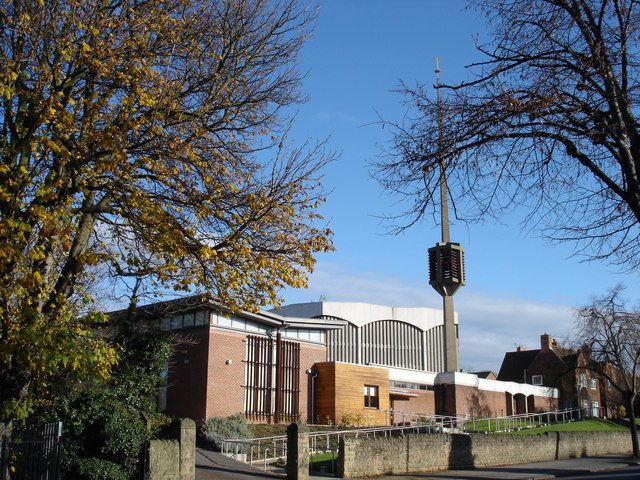
Nottingham ‘Heritage at Risk’ church gets Christmas grant to fix crumbling concrete tower
The concrete tower at The Church of the Good Shepherd is crumbling. It is rated by Historic England as a Category A – of ‘Immediate risk of further rapid deterioration or loss of fabric’.
It is now local people who bear the burden of ensuring this Grade II* Listed church can stay open and in use. There is no consistent UK-Government support available to keep churches in good repair – even if they’re of historic significance.
Architect Gerald Goalen won an award from the Royal Institute of British Architects in 1966 for the building, two years after the church opened. It is home to a pipe organ by JW Walker & Sons and a relic of St Gilbert, displayed to the left of the altar.
But all of this is at risk as the concrete tower deteriorates.
The team at the Good Shepherd are doing all they can to keep the historic place of worship in good condition. They have been planning this work and working hard to raise the funds for over two years now. But the church is deteriorating faster than they can raise the funds to save it.
This is a hugely diverse and busy church that is open for 12 hours every day, with over 1000 people attending services throughout the week. It is also used by the wider community for concerts, singalongs, Civic services and it is visited internationally by visitors due to its historic significance and exceptional stained glass.
Unless urgent action is taken, the building will become unsafe to use.
Thankfully, help is at hand. The church is to share in a Christmas gift – an urgent pay out from the National Churches Trust – of more than £900,000 designed to keep UK churches open and in use.
The Church of the Good Shepherd has been awarded a £25,000 grant from the National Churches Trust. On the recommendation of the National Churches Trust, the church will also receive a £10,000 Wolfson Fabric Repair Grant from the Wolfson Foundation.
This is great news and will be a firm step in helping to remove the church from Historic England’s Heritage at Risk Register – ensuring the church can remain open and able to serve its local community.
The Church of the Good Shepherd is one of 976 churches, chapels, meeting houses and cathedrals on Historic England’s Heritage at Risk Register. The future of church buildings is a heritage crisis; so many important Grade I, Grade II* and Grade II church buildings – some of our nation’s most significant buildings – need urgent repairs. Without action, we will lose these buildings. Once they’re gone, they’re gone forever.
Claire Walker, Chief Executive of the National Churches Trust, said:
“The National Churches Trust is delighted to be able to support The Church of the Good Shepherd to enable them to carry out urgent tower repairs to their beautiful building. Not only will this protect this important heritage, but it will help to keep the church building open and serving local people.”
“Whether seeking quiet reflection, access to community services or a place to worship, the National Churches Trust helps hundreds of churches each year and with the support of local people, keeps them thriving today and tomorrow.”
Paul Ramsbottom, Chief Executive of the Wolfson Foundation, said:
“At the heart of local communities sits churches: places of worship, places of support for local people and places of shared heritage. The Wolfson Foundation has a particular interest in the heritage of these remarkable buildings, and we are pleased to continue our partnership with the National Churches Trust to help keep them open, safe and in fine condition for the future.”
Canon Philipp Ziomek, of the Church of the Good Shepherd, said:
“We’re delighted to receive this grant towards the repair of our church spire and bell tower. Our bell tower is a symbol for our church – a call to the community to join us and a beacon of hope.”
“When we first realised there were issues with the tower, we started fundraising but the cost of the repairs – not just the bell tower but also the wider 1960s concrete façade – means repair costs are rising faster than we can fundraise to save our church.”
“Grants like these are a lifeline, which enable us to move forward with the repairs to our church spire, and which help us keep our church open for the community to enjoy.”
How the grant will help the church
The defective concrete will be replaced. Replastering and repairs will be carried out. There will also be other repairs to help combat damp within the building.
More about the church and the heritage that is at risk
The Church of the Good Shepherd in Nottingham is a stunning modern Grade II* Listed building.
It was designed by Gerard Goalen and opened on 23 July 1964. Goalen won an award from the Royal Institute of British Architects in 1966 for his work on the building.
The stained glass is ‘Dalle de verre’, a French style where the glass is shaped by breaking with a hammer or cutting with a saw. The edges of the resulting pieces may be chipped or faceted to increase the refraction and reflection effects of the glass. The stained glass in the Church of the Good Shepherd was by Patrick Reyntiens OBE (11 December 1925 – 25 October 2021), a British stained-glass artist, often described as “the leading practitioner of stained glass in this country”.
The church is open every day to parishioners and the general public, so all can enjoy this beautiful building.
Claire Walker, Chief Executive of the National Churches Trust, said:
“Changes by the Government to the Listed Places of Worship Grants Scheme have effectively imposed VAT on listed churches that need any major repairs. This will be unaffordable to many of them as the burden of caring for these buildings already falls onto local people and could lead to even more churches falling into disrepair or closing completely.”
“There are already almost 1000 churches on the Heritage at Risk Register in England, rising every year. But this is about more than just heritage – churches host and run support for local people; mental health groups, food banks, warm spaces and parent and toddler groups, which would be impossible for local authorities to fund and run if the church was forced to close. We should be making it easier for churches to help local people – not cut off vital funding that keeps these important buildings open.”
“The VAT scheme must be made permanent, and its cap removed in the upcoming spending review to protect our church heritage and to see these buildings kept open and serving local people.”